Balaur - A Deterministic 2D and 3D Game Engine in Rust
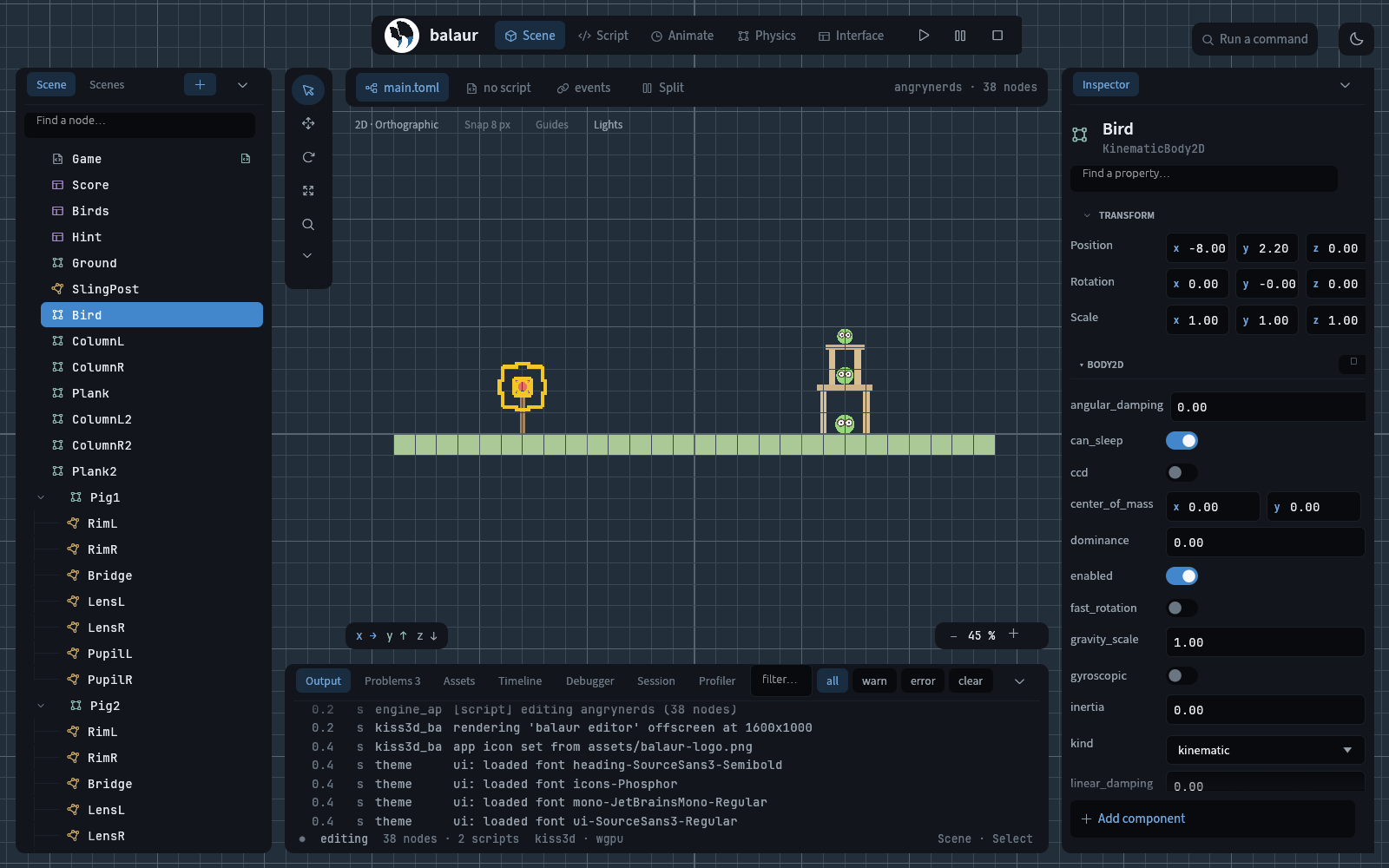
I have been building a game engine in Rust together with Sébastien Crozet, the author of Rapier (the physics engine behind Godot Rapier Physics). It’s called Balaur: 2D and 3D, MIT, open source.
- Website: balaurengine.org
- GitHub: balaurengine/balaur
- Docs: Introduction · Features · Roadmap
Contents:
- Why another engine
- Hot reload in milliseconds
- Determinism, always on
- Scenes are TOML
- What is in the engine today
- The editor is a Balaur project
- Ship as one file
- Built on the Rust ecosystem
- Try it
Why another engine
Three things I kept hitting while fixing bugs in Godot:
- Determinism. Rollback netcode, lockstep multiplayer, replays, reproducible bug reports. Same inputs have to give the same bits on every machine. Hard to add to an engine later.
- Fixing things myself. In a big engine a fix waits on review, a merge and the next release. I wanted to fix a bug and ship with it the same day.
- Shipping small. One executable, no sources, no compiler inside. On the web, Godot 4.7’s export template is 38.8 MB of wasm - 6.9 MB brotli, which is what a host actually serves - before the game’s own data. Balaur’s web template is 17 MB, or 4.5 MB brotli.
So I am making my own. On top: a scene tree of named nodes with scripts, like in Godot. Underneath: every node is an ECS entity and every subsystem is a plugin. Only plugin authors see that layer.
It is 0.1.0: builds from source, no binary release yet. The comparison page says when to pick Godot, Bevy or Fyrox instead.
Hot reload in milliseconds
Save a script while the game runs. New code is live in milliseconds, state survives.
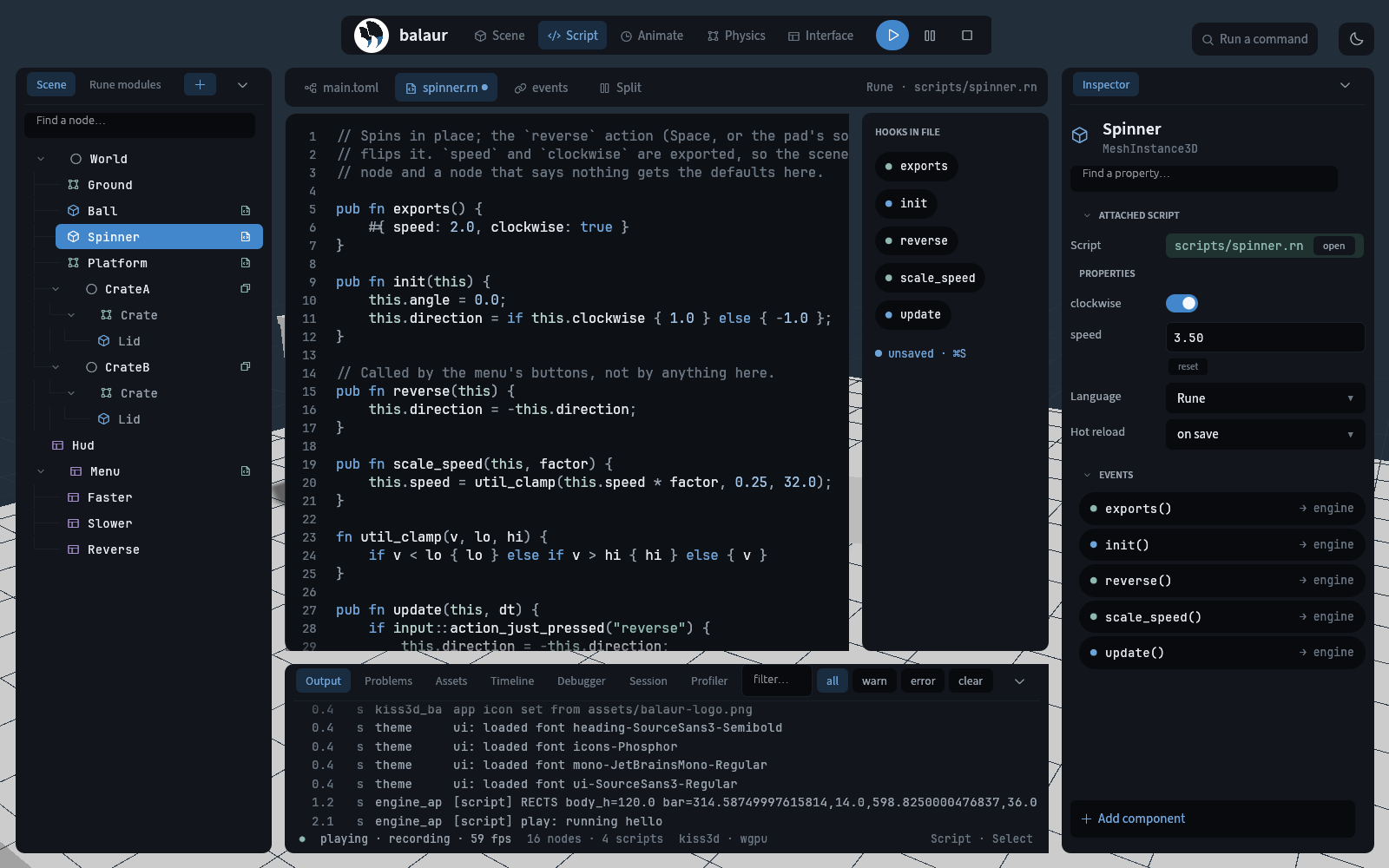
Scripts are Rune: Rust syntax without the types, async/await, no build step.
// scripts/spinner.rn
pub fn init(this) { this.angle = 0.0; }

pub fn update(this, dt) {
    this.angle += dt;
    this.node.set_rotation_euler(0.0, this.angle, 0.0);
}
- A script that does not compile shows file, line and caret in the editor. The running code stays up.
- Debugger: breakpoints in the gutter,
F5/F10/F11/Shift+F11, frames and locals. The game freezes, the editor stays live. - No Rust needed to make a game. Scenes are TOML, game code is Rune. Rust or C is for plugins.
More in Scripting.
Determinism, always on
Simulation runs in fixed_update(dt) at 60 Hz. Every tick hashes the world into a digest.
balaur run my-game --fixed-tick --record session.blr
balaur replay session.blr --verify          # stops at the first tick that disagrees
- A recording stores input, not state. Minutes of play is kilobytes.
- CI compares digests across three operating systems. A change that alters a digest without saying why does not merge.
- Rapier runs with
enhanced-determinism, libm does the transcendentals, Rune is forked sopowf/powimatch everywhere. - Network replies land at the start of a tick, in order. A replay covers logins and retries without touching the network.
This is what lockstep and rollback multiplayer need. Details in Determinism.
Scenes are TOML
[[nodes]]
name = "Ball"
position = [0.0, 6.0, 0.0]
script = "scripts/ball.rn"
body3d = "dynamic"
collider3d = { kind = "ball", radius = 0.5 }
shape3d = { kind = "ball", radius = 0.5 }
body3d, collider3d and shape3d are components from the physics and render plugins. One registration = scene key + script call + inspector row. See Scenes and nodes.
What is in the engine today
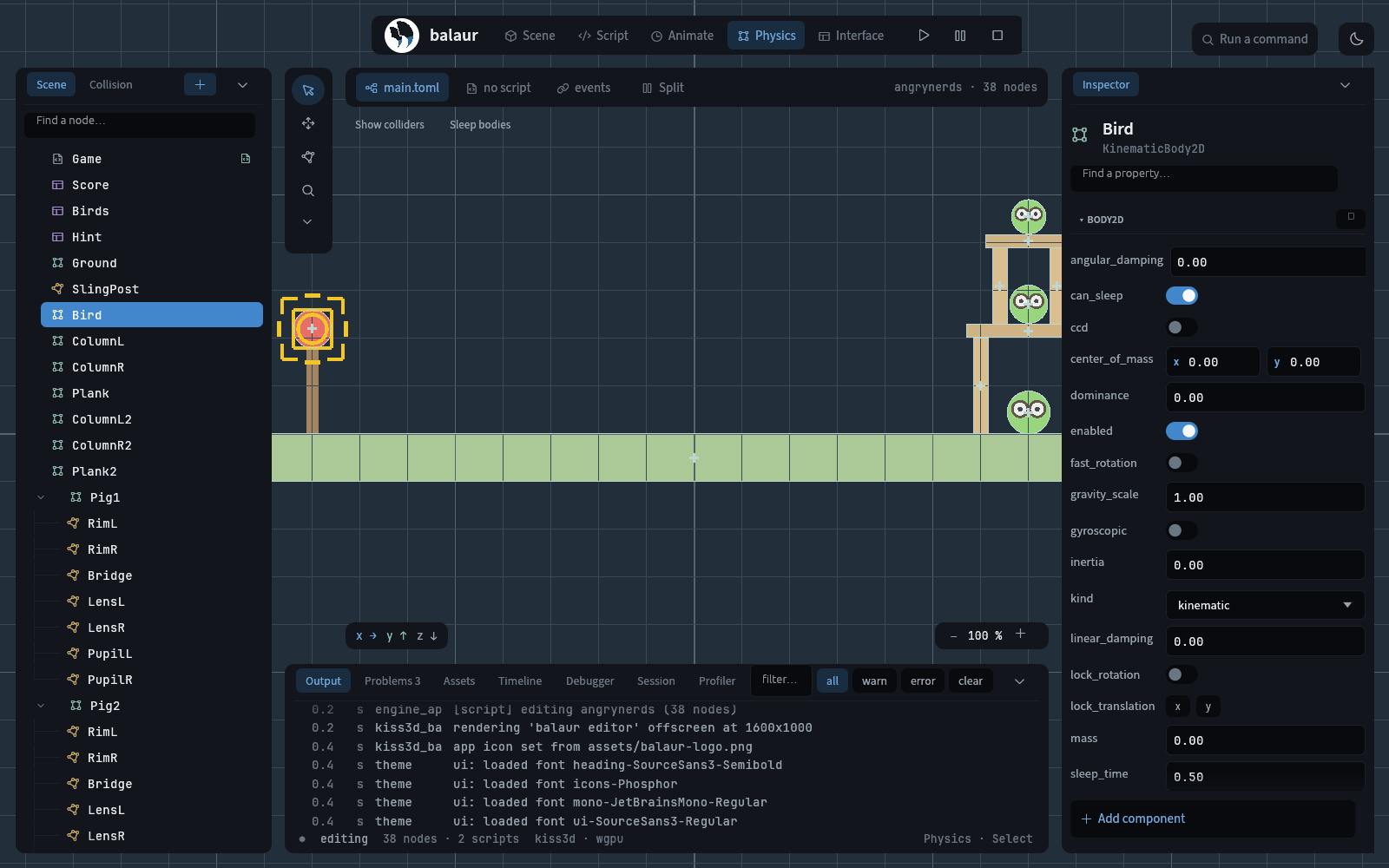
Physics - 2D and 3D through Rapier, fixed 60 Hz step, collider and centre-of-mass overlays in the editor.
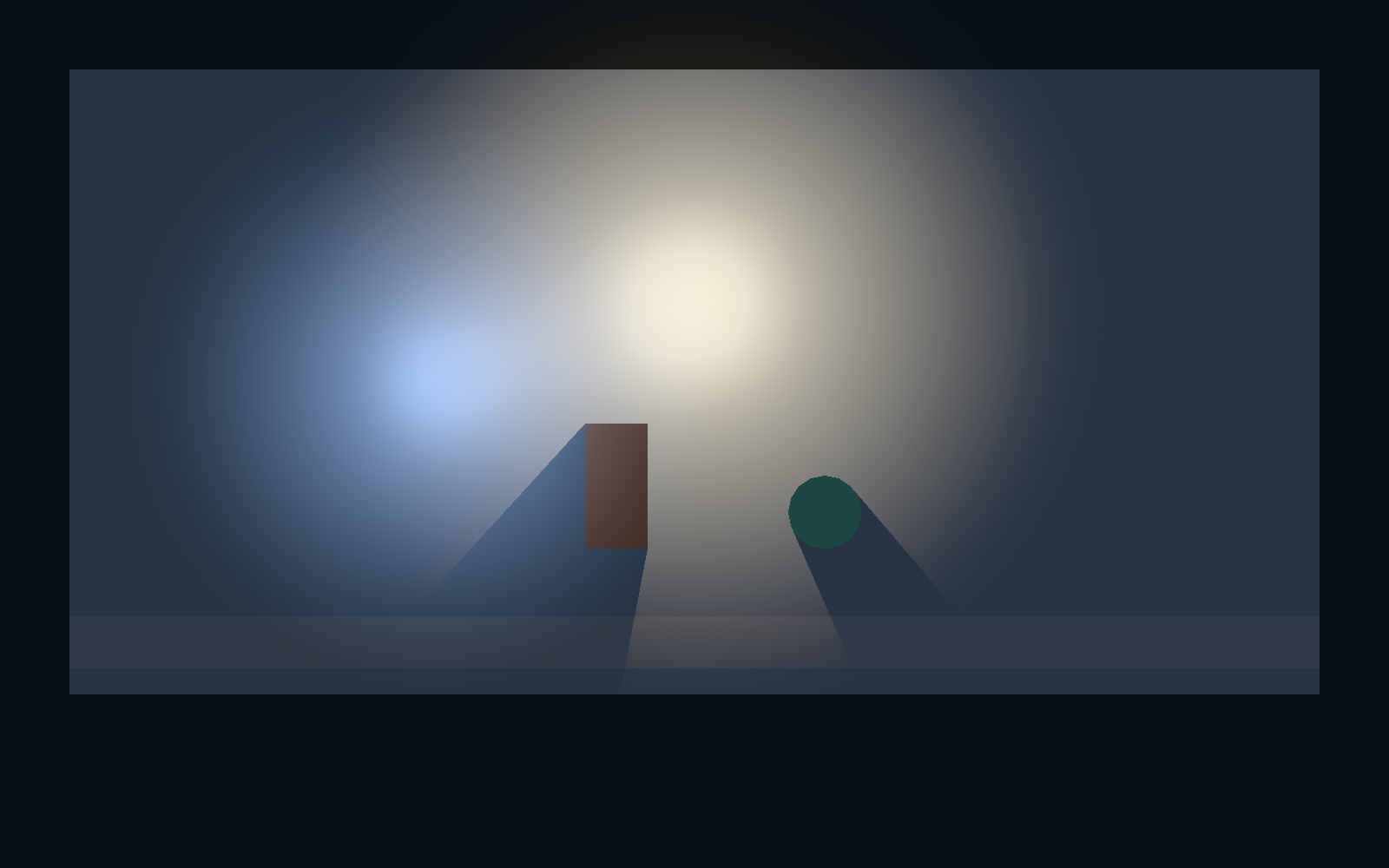
Rendering - 2D and 3D on wgpu: sprites, tile maps, particles, meshes. 2D lights and occluders build a light map, post-processing on top.
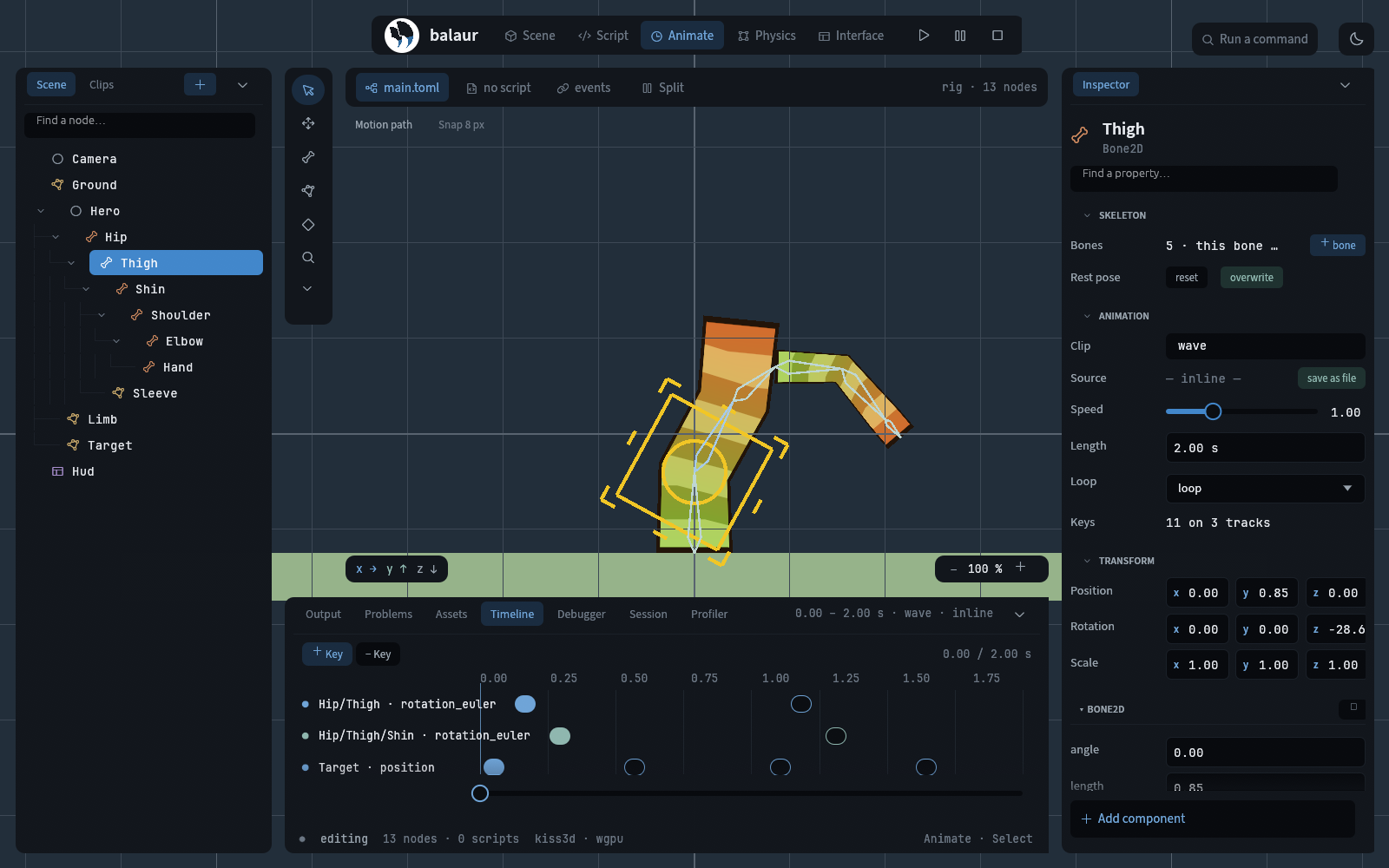
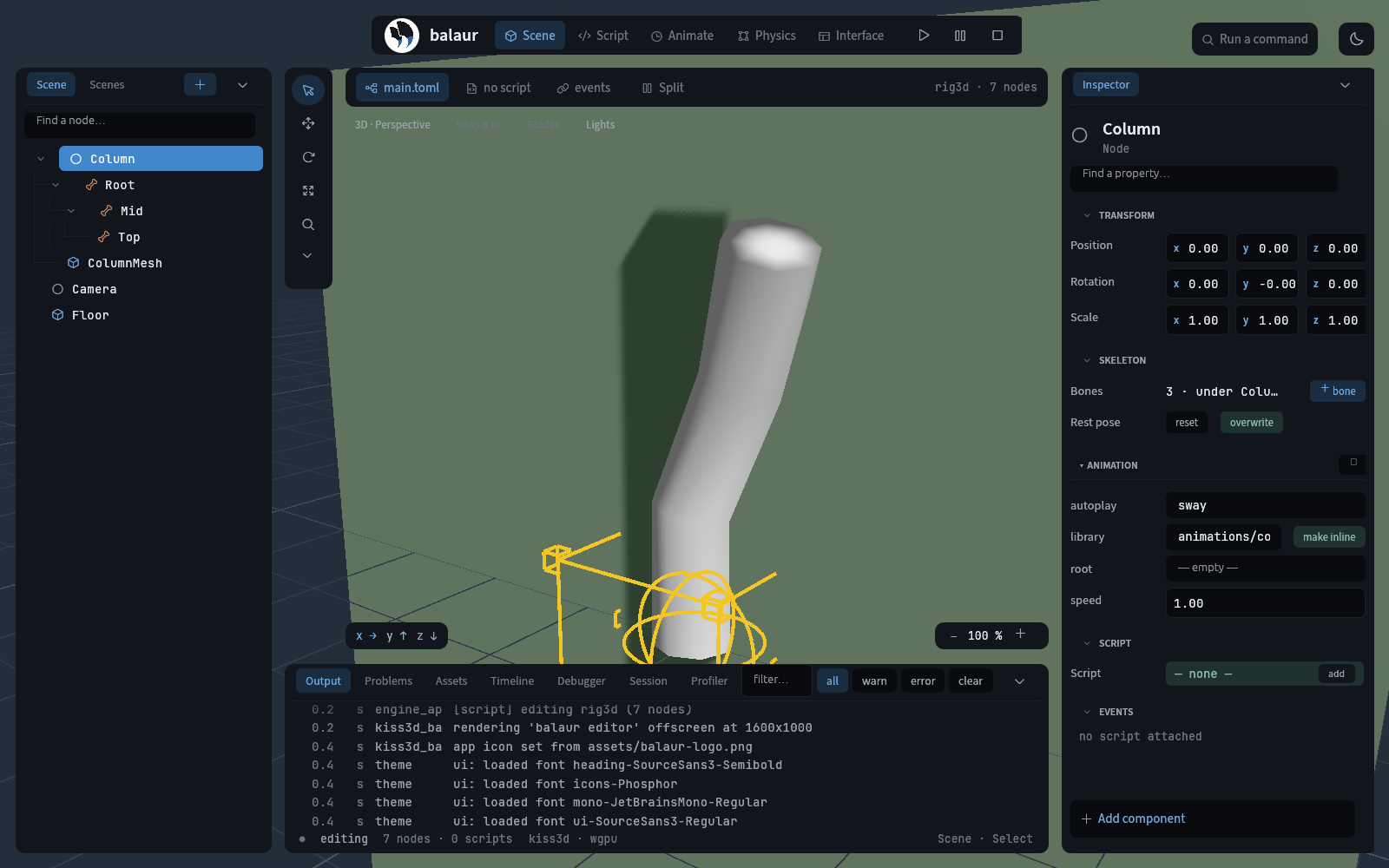
Animation - clips, tweens, twelve easings, method tracks. 2D bones with skinned polygons, 3D rigs from glTF, look_at and two_bone_ik.
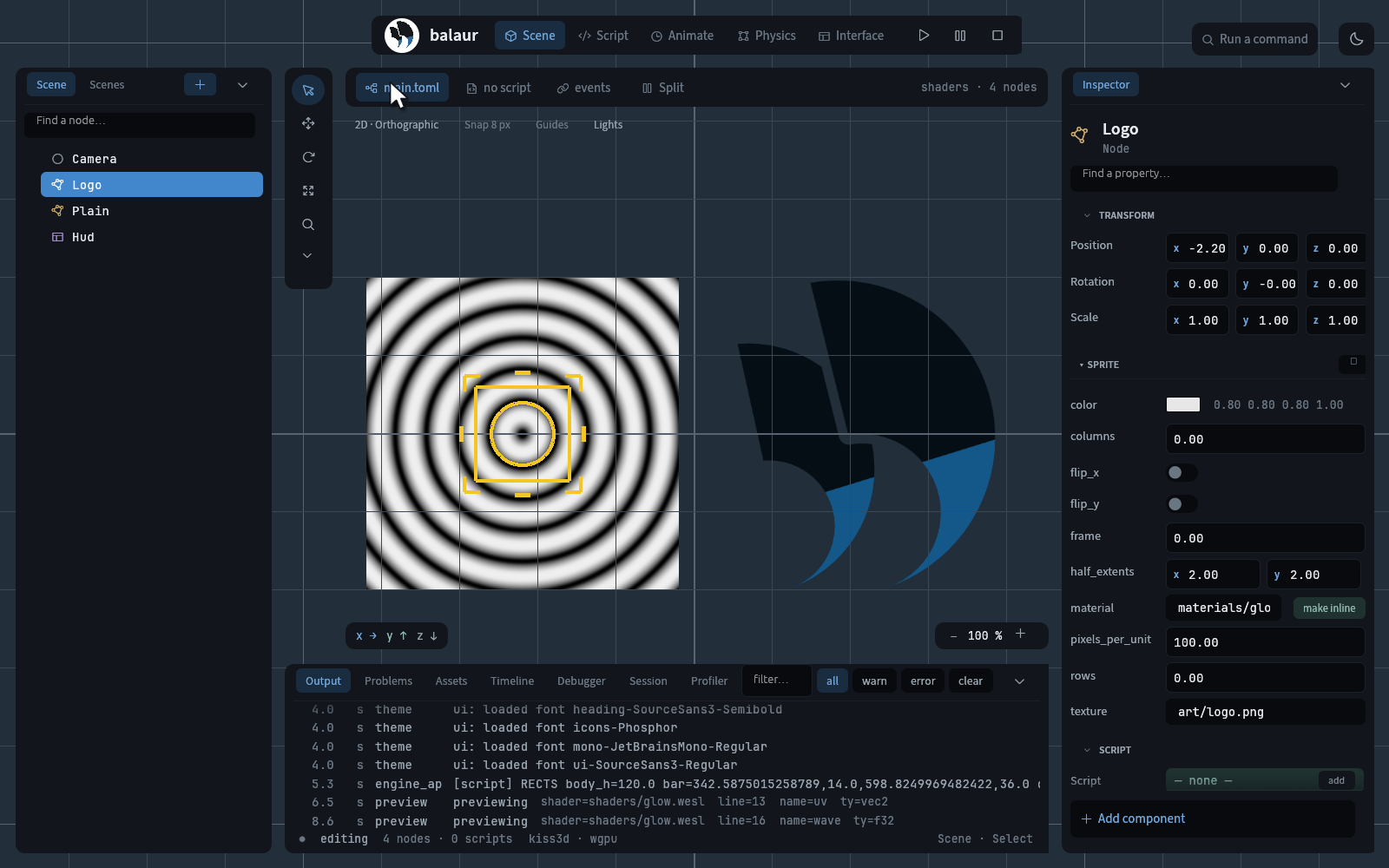
Shaders - WESL (WGSL with imports and variants) in material assets, linked at run time.
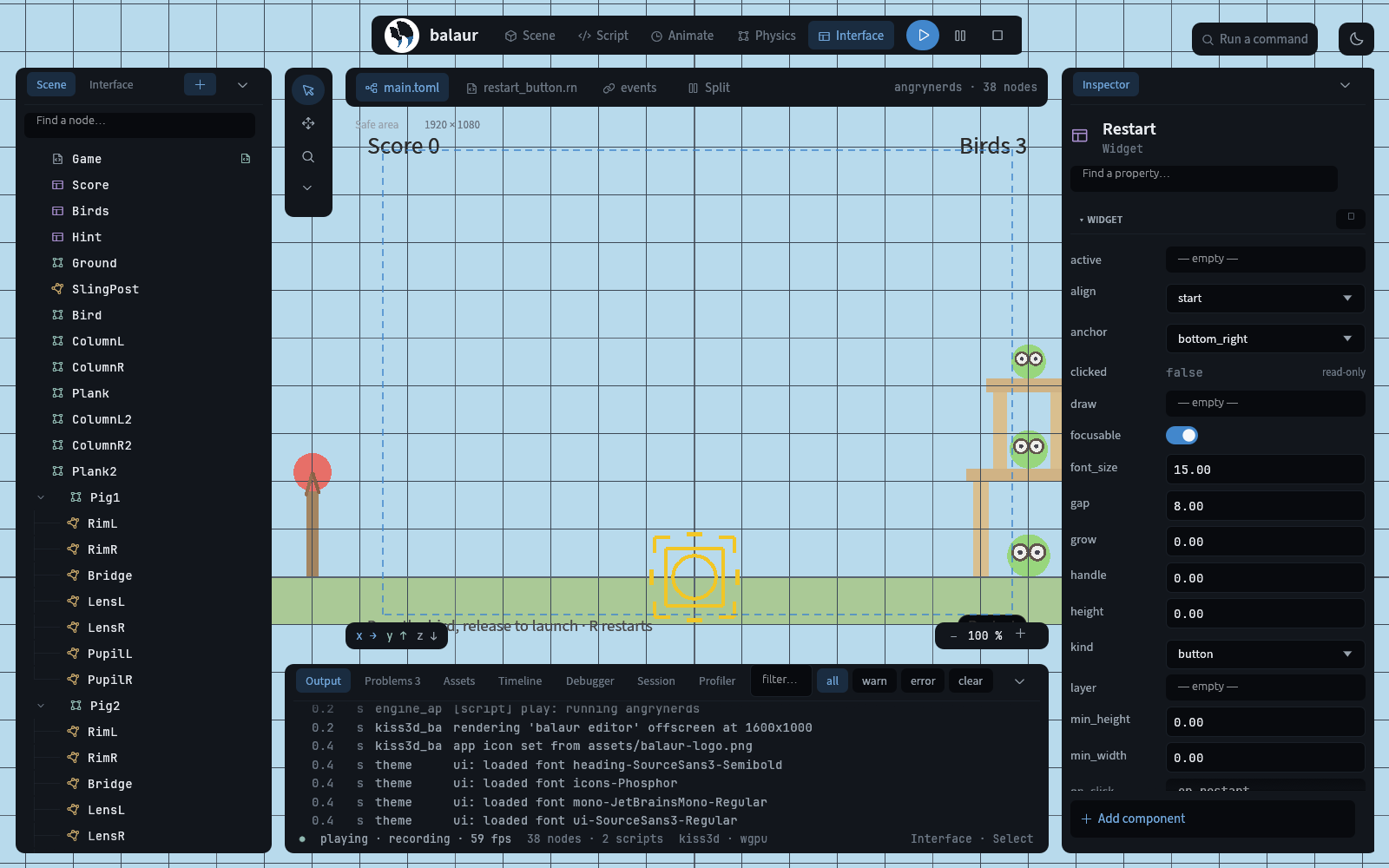
UI - widgets for HUDs, immediate-mode API for tools.
Audio and input - rodio; keyboard, mouse, gamepads, touch.
Networking - HTTP and websockets with compression, delivered once per tick, replayable. Gamend on top, the same backend from Gamend and the stress test: login, REST, realtime rooms, server hooks.
Stores - sign-in, achievements, leaderboards, cloud saves, purchases. Game Center, iCloud and StoreKit today.
Full list on Features. What is missing is on the Roadmap, each item linked to its plan.
The editor is a Balaur project
One binary is the editor, the CLI and every game’s runtime. The editor is itself a Balaur project, so editing an editor script hot reloads the editor.
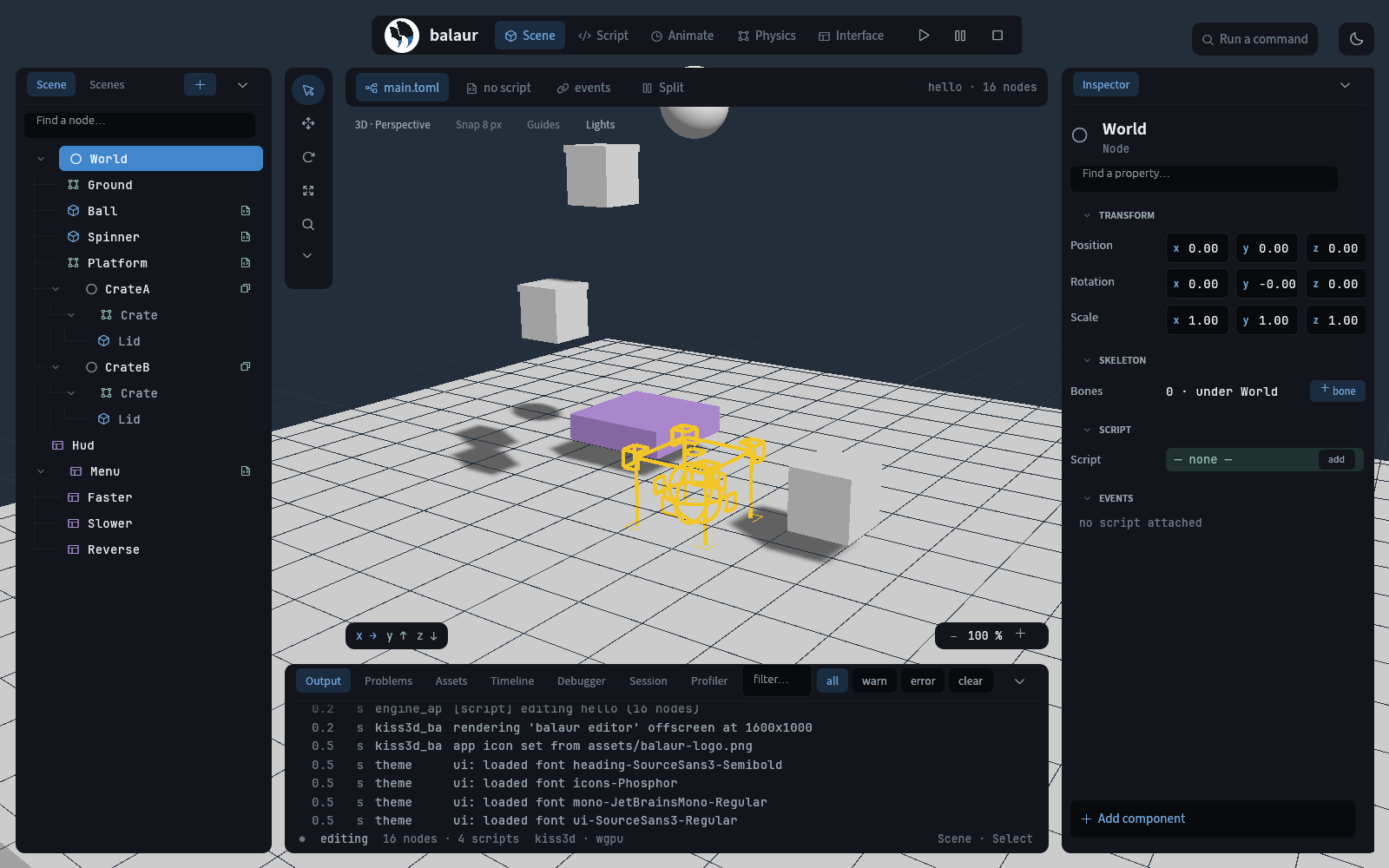
Tree, inspector, gizmos, timeline, rig tools, play-in-editor, undo. Docks, tools, commands and inspector sections can come from a project’s own Rune files. More in The editor.
Ship as one file
balaur new my-game
balaur run my-game                  # dev mode, hot reload on
balaur export my-game               # scripts to bytecode, assets into my-game.bpak
balaur play my-game.bpak            # run the pack, no compiler, no watcher
balaur edit my-game                 # open in the editor
export --target <platform> fuses the pack onto a runtime: one executable, no compiler, no sources inside.
Three run modes, same simulation:
| Mode | GPU | Window | What it is for |
|---|---|---|---|
| headless | no | no | tests, CI, servers, determinism runs |
| offscreen | yes | no | screenshots, automation, visual CI |
| windowed | yes | yes | playing and editing |
Windows, macOS and Linux today. iOS, Android and WebAssembly compile in CI; the browser canvas runtime is on the roadmap. See Shipping a game.
Built on the Rust ecosystem
Reuse, don’t rewrite:
- hecs - ECS
- Rapier - physics
- wgpu via kiss3d - rendering
- egui - immediate-mode UI and the editor
- rodio - audio
- gilrs - gamepads
- Rune - scripting
- glam + libm - math
Full list on Built on. Every crate is generated into the reference from a booted engine, so the docs cannot drift.
Try it
git clone https://github.com/balaurengine/balaur
cd balaur
cargo run -p balaur_cli -- new my-game
cargo run -p balaur_cli -- run my-game
Needs a stable Rust toolchain. Getting started · FAQ.
Contributions welcome, AI-assisted too, same bar: you understand and stand behind every line, and it comes with tests and docs. Principles say how the project is run. Propose big things in Discussions, bugs go in issues. A star on balaurengine/balaur helps.